
Introduction
In Part 1 of this series, we looked at three full-lifecycle platforms — Crowdworx, HYPE, and Itonics — designed to manage both idea and innovation processes end-to-end with advanced features. Crowdworx in particular stood out for its combination of continuous idea management, advanced evaluation tools, multilingual collaboration, AI-driven features, and automated workflows, making it especially suitable for large, global organizations.
This article turns to platforms that take a different approach. Wazoku, Innovationcast, Brightidea, and IdeaScale focus primarily on time-boxed challenges and campaigns. These tools are widely used to source ideas around specific themes or problems, but generally offer fewer features for managing the full innovation lifecycle at scale. Among them, Wazoku stands out for its ecosystem management and market intelligence capabilities, although it still offers fewer possibilities than full-lifecycle platforms like Crowdworx.
What Challenge-Driven Platforms Offer
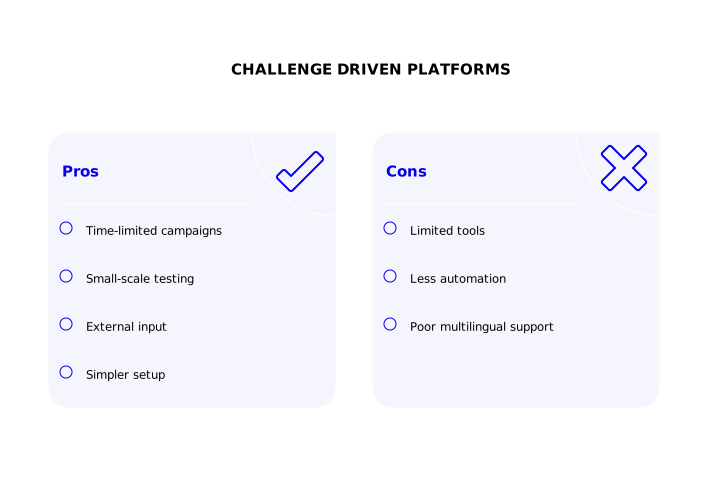
Challenge-driven platforms are ideal for:
Running time-limited campaigns to collect ideas around specific topics.
Testing innovation on a small scale before rolling out enterprise programs.
Gathering input from external stakeholders such as customers, suppliers, or partners.
Operating with a simpler setup and lower entry costs compared to enterprise systems.
However, because their focus is on campaigns, they usually provide fewer tools for continuous idea management, automated workflows, or multilingual collaboration. This makes them suitable for targeted initiatives but less capable of managing the entire innovation process.
Wazoku: Idea Management with a Focus on Challenges and Market Intelligence
Wazoku combines idea challenges with access to external market intelligence. It offers tools for collecting and evaluating ideas, but relies heavily on challenge-driven campaigns rather than continuous idea management. Some features are strong, such as customizable evaluations, but other areas like multilingual collaboration and automation are more limited.
Collecting Ideas
Ideas are collected primarily through challenges, enabling focused ideation.
No permanent submission channels for continuous idea intake.
Managing and Viewing Ideas
Standard idea lists with normal filtering and sorting capabilities.
Limited options to customize views for different user groups.
Evaluating Ideas
Customizable evaluation criteria and scoring capabilities, including:
Numeric scales
Categorial scales
Financial measures
Yes/No questions
Evaluation is built around the challenge model rather than ongoing programs.
AI Capabilities
AI assistant to help users find ideas of interest.
AI-powered analytics to identify patterns, predict trends, and generate insights.
Automation at Scale
Customizable workflows, but mostly manually operated.
Limited automation of matching or routing tasks compared to more advanced systems.
Workflows
Customizable multi-stage evaluation workflows per challenge.
Workflows are manually run and need to be configured for each campaign.
Multilingual Collaboration
Basic, partially automated translation capabilities.
Each idea translation must be manually triggered.
Other content such as decisions and evaluations is not translated.
Idea Challenges
Idea challenges are Wazoku’s main strength.
Flexible challenge creation and customization options.
Multi-stage evaluation workflows.
Automated participant communications during campaigns.
Real-time analytics to track challenge performance.
Summary
Wazoku provides a solid foundation for challenge-based idea collection and evaluation, supported by access to external market intelligence. While it offers useful AI analytics, its multilingual and automation features are less advanced, making it more suited to organizations focused on running structured campaigns rather than continuous idea management.
IdeaScale: Community-Oriented Idea Challenges
IdeaScale is centered around idea challenges and community spaces. It offers tools for capturing and evaluating ideas and includes some AI-based analytics, but it remains focused on challenges rather than continuous idea management.
Collecting Ideas
Simple idea campaign module with easy-to-use submission forms.
Designed for running campaigns rather than ongoing idea intake.
Managing and Viewing Ideas
Standardized idea lists with limited customization.
Recently improved filtering options for easier navigation.
Evaluating Ideas
Main evaluation method is a 5-stage scale.
Admin can configure any number of criteria, each rated on the 5-stage scale.
Limited variety compared to more advanced platforms.
AI Capabilities
Built on U.S. AI models such as OpenAI and Llama.
AI tools include:
Idea Word Cloud to show themes and phrases
Scatterplot of high impact and high feasibility ideas
Community Sentiment Insights to highlight key themes
Comparative analysis between 2–5 ideas
Innovation Program Health Check to assess diversity of ideas
Automation at Scale
Simple Automation Builder for routing ideas based on thresholds.
Conditions include number of votes, comment count, tags, or stage reached.
Actions include changing stage, adding labels, executing Webhooks, or notifying Slack channels/groups.
Workflows
Stage-based workflows with customizable steps.
Automation rules trigger actions like changing stage or notifying a group.
Multilingual Collaboration
Ideas are displayed in the user’s preferred language.
Comments, evaluations, and decisions are not translated.
Idea Challenges
Core functionality of IdeaScale since 2009.
Features include:
Quick setup with templates
Customizable submission forms
Predefined or custom workflows
Custom evaluation workflows with automations
Associating challenges with communities inside the organization
Reporting charts
Ability to deploy internally or externally
Summary
IdeaScale focuses on idea challenges and community-driven innovation. It provides useful AI-based analytics and a simple automation builder, but evaluation methods and multilingual collaboration are limited compared to more comprehensive platforms.
Brightidea: Challenge-Centric Idea Management
Brightidea is built around idea challenges. It uses its Challenge module to support a range of use cases such as ideation, cost-saving campaigns, or venture scouting. While it offers several useful features for idea submission and evaluation, its focus on challenges means fewer options for continuous idea management and limited multilingual capabilities.
Collecting Ideas
Ideas are submitted via Brightidea’s Campaign module.
Mobile and desktop submission forms available.
Submission forms can be customized to a limited extent.
Managing and Viewing Ideas
Standardized idea lists with fixed filters and sorting options.
Limited ability to customize views for different user groups.
Evaluating Ideas
Brightidea’s challenges support several evaluation methods:
Single scale slider for fast reviews
Stack ranking (sorting ideas by preference)
Scorecards with numeric and categorial criteria
AI Capabilities
AI-powered user recommendation engine.
AI submission assistant to help generate idea descriptions.
AI-generated idea images to enrich submissions.
Automation at Scale
Rule engine to automate when an idea moves to the next stage.
Automations based on previous evaluations and decisions.
Workflows
Workflow engine moves ideas automatically through the innovation process.
Rules can be customized or loaded from templates.
Multilingual Collaboration
Ideas can be translated into up to six languages.
Comments, evaluations, and decisions are not translated.
Idea Challenges
Brightidea’s main functionality is its Idea Challenge module.
Features include:
Templates for creating challenges
Custom submission forms
Custom challenge phases and evaluation workflows
Rule-based automations
Reporting charts
Ability to deploy challenges internally or externally
Summary
Brightidea focuses on idea challenges as its core strength. It provides a range of evaluation methods, basic AI support, and automation through its rule engine. However, it is less suited for continuous idea management and offers limited multilingual translation beyond ideas themselves.
Comparison Table — Challenge vs. Full-Lifecycle Features
Feature | Wazoku | Innovationcast | Brightidea | IdeaScale | Crowdworx |
Idea Collection (continuous) | None | None | None | None | Yes |
Idea Challenges (strong) | Yes | Yes | Yes | Yes | Yes |
AI Capabilities | Advanced | None | Basic AI features | Limited analytics | Yes, advanced |
Automation / Workflows | Limited | Minimal | Moderate Rule Engine | Simple Automation Builder | Yes, advanced |
Multilingual Collaboration | Basic manual | None | Partial (ideas only) | Ideas only | Yes, automatic translations |
Portfolio / Project Management | None | None | None | None | Yes |
This table highlights how challenge-driven platforms focus on campaign functionality but lack continuous intake, multilingual automation, and portfolio integration.
How to match software features to your business needs
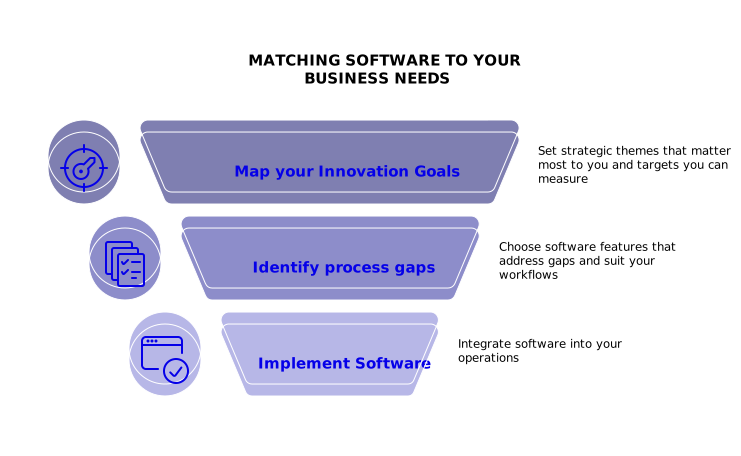
The right idea management software matches your organization’s specific needs with the platform’s capabilities. A clear strategy that ties to your business goals sets the foundation for successful idea management. A good approach is to start by defining what you want to achieve, identify gaps in your current processes, and then select a platform that supports those needs.
For organizations running enterprise-scale innovation, full-lifecycle platforms (as covered in Part 1) provide the advanced capabilities needed to manage ideas and innovation end-to-end. For those testing innovation or running focused campaigns, a challenge-driven platform may be sufficient.
Mapping your innovation goals
Your innovation program needs clear success markers. Set targets you can measure, like higher revenue, better customer satisfaction scores, or specific sustainability goals. Research shows companies that measure their breakthroughs are 37% more likely to outperform others. You might need to focus on getting more internal ideas, making better use of customer feedback, or working more closely with external partners like universities.
Think about which innovation goals need extra support; what strategic themes matter most to you, and how will you measure innovation success.
Moreover, are you aiming to:
Increase employee participation?
Collect customer insights?
Run focused campaigns around a strategic theme such as sustainability or digital transformation?
Defining these objectives makes it easier to choose between lighter, campaign-based tools and more comprehensive platforms.
Identifying current process gaps
Take a good look at how your organization handles ideas right now. Most companies still use manual, time-consuming methods such as emails, spreadsheets, brainstorming sessions, or old-school suggestion boxes. These approaches often fail to get employees involved and rarely lead to meaningful breakthroughs.
A detailed gap analysis shows where current systems fall short. Common issues include:
No way to track an idea’s results or report outcomes
Random submission methods
Lost ideas with no status updates
Poor review methods
Limited team collaboration
Aligning features with team workflows
Your goals and gaps point to which features matter most. Here’s what to look for:
Your idea collection should feel natural to your teams. Look for platforms that support various formats—from internal hackathons to ongoing idea challenges—in one system. People will share more ideas when the process is simple and user-friendly.
System connections play a big role in success. The best platforms merge naturally with core tools like Microsoft 365. Fewer login screens mean more people will use the system.
Note that breakthroughs happen when innovation becomes part of daily work. The best software fits your business’s way of working, not the other way around. Useful features to look for include:
Easy-to-use submission forms.
Flexible evaluation options (simple voting, scorecards, or criteria-based reviews).
Community interaction, such as comments and likes, to boost engagement.
Integrations with tools your teams already use, so adoption feels natural.
Don’t trust the brochure: How to validate your software choiceStuff
Proving your idea management software choice right needs ground evidence that goes beyond marketing promises and feature lists. Companies often end up with powerful tools that don’t match their needs when they rely only on vendor claims. You should gather independent insights that show how platforms work in environments like yours.
Use review platforms wisely
Review sites like G2 and Capterra are a great way to get views with over 4,000 verified user reviews. These sites need careful filtering though. Many “idea management” categories include irrelevant general-purpose tools like Monday.com or Trello. These tools excel at task tracking but lack state-of-the-art specific capabilities. Look for reviews from innovation leaders in companies that match yours. Focus on feature relevance and business outcomes rather than popularity rankings.
Demand demos that match your reality
A customized demonstration shows you how a platform handles your specific requirements. Skip generic walkthroughs and ask for sessions that line up with your use cases—whether you run idea campaigns or lead continuous improvement initiatives. This reveals the platform’s flexibility, usability, and performance under your conditions.
Analyze case studies and ROI examples
Results tell the true story of a platform’s success. To name just one example, SIEMENS Helathineers generated 1,3000 ideas and achieved 3 Million Euro savings through their idea management implementation with Crowdworx. This is a big deal as it means that quality case studies should show measurable effects with specific metrics. Crowdworx users at SFS saw over 2,000 ideas within the first 6 months and achieved an implementation rate of 83%, proving that real numbers matter more than testimonials.
Common mistakes to avoid when choosing a platform
Companies can make several mistakes when they choose an idea management platform. These mistakes can throw off even the most carefully planned innovation projects. Early awareness of these common pitfalls helps you avoid getting pricey implementation failures.
Overlooking integration needs
Features often grab the spotlight while system connectivity takes a backseat. Your idea management software’s integration capabilities play a crucial role in the selection process – the platform should blend naturally with your current innovation and development tools. Many companies find out too late that vendors market basic integrations. These turn out to be their standard platform squeezed into an iframe instead of true native integrations. Poor integration combined with these limitations creates friction and hurts adoption.
Ignoring user experience and adoption
The success of any platform depends heavily on user experience. Gartner reports that more than 80% of collaboration efforts fail because people don’t use them. The numbers get worse – apps lose 77% of their users in three days, followed by 95% within 90 days. Advanced features mean nothing if a complex interface with lengthy forms blocks participation. Your best bet is a platform with a clean, user-friendly interface that makes learning quick and easy.
Choosing based on popularity, not fit
Popularity rankings can be misleading. Review sites often list general-purpose tools like Monday.com or Trello under “idea management” categories. These tools lack specialized innovation features. Smart companies focus on reviews from innovation leaders in similar organizations and look at actual business results rather than popularity metrics.